The BIPOC/ACCUTE First Person Interviews series captures the stories and perspectives of BIPOC members of ACCUTE from different parts of Canada at different stages of their teaching, research, or graduate student careers. The interviews are presented in real-life language and dialogue style to enable us to present participants’ stories and experiences in their own voices.
We are starting this new year, post ACCUTE 2026 conference, with conversations with two of our members who won the ACCUTE BIPOC Caucus Research and Community Engagement Award. We look forward to engaging with other winners as well as with members who identify with our caucus. If you are interested in joining the First Person BIPOC/ACCUTE series, please reach out to cezenwa@mun.ca and info.accute@gmail.com We hope you enjoy reading our members’ stories and look forward to hearing from you. — Chinelo Ezenwa.
Chinelo
My name is Chinelo Ezenwa. I am an Igbo woman and a settler scholar in Canada. I currently work as an Assistant professor of Black Atlantic Decolonial Literatures at Memorial University. Thank you for joining our conversation, Onyeka! Please could you introduce yourself to our readers.
Onyeka
Thank you very much, Chinelo. My name is Onyeka. I am a PhD Candidate in the Department of English at the University of Calgary. I came to Canada in the Winter of 2023. I started my PhD programme in the Department of English, and my research interests cut across migration, African immigrant experiences, and how African migrants try to manage their traumatic experiences, especially without medicalized or institutionalized intervention frameworks. Generally, my research focuses on the experiences of those at the margins, whether it is immigrants, refugees, or any other kind of marginal identity.
Chinelo
We are really excited to have you. Congratulations on winning the ACCUTE BIPOC Caucus’ Research and Community Engagement Award in 2025. Before we go further, I was wondering if you would like to reflect a bit on the award, why you applied, and what it felt like to be one of the winners.
Onyeka
It felt great to be a 2025 winner of the ACCUTE BIPOC Caucus’ Research and Community Engagement Award. It is always amazing to be recognized for something positive that you have done. This is the aspect of human society that is often taken for granted, because we live in a world where criticism for something negative done is always higher than the appreciation for something positive – after all, the media people will tell us that oddity or negativity is what makes news headlines.
I applied for the award because there are many things, in terms of peer support and community service, that we (BIPOCs) do that go unnoticed. When I say “unnoticed,” I am not even accusing the state or its institutions of ignoring the contributions of the BIPOC folks. The overlooking of minoritized groups’ services, in this sense, is something that we ourselves are often guilty of. I, for one, never thought that some of the things I did that got me the award were worth documenting before I saw the call for applications for the award. But when I saw the call, I thought through my work, both research and services, and I saw that I was actually contributing in no small way in terms of stimulating the human potential of some of my peers to also succeed in different ways, and also building community through that process, in my little way. And I decided to apply, not sure if I stood a chance, but happy in the fact that this award had pushed me to recognize my own contributions, document them, and be intentional about making such contributions going forward.
And the reason we (BIPOCs) can do so much in terms of community engagement and not feel compelled to add them to our CV or even feel that we are making a positive change is that some of us, I believe, came originally from places where state and government apparatuses are dysfunctional. We thrived on peer support and self-reliance. So, if you spent time in such a society where helping others, building community, peer support, and collaborative learning and growth are part of your lifestyle, rather than what people do for recognition, it will definitely feel special if you are then recognized for doing what you had done as a basic mundane practice.
If the award is sustained, I believe it will encourage more BIPOC individuals to do more in their communities, because, whether we like it or not, not all problems can be addressed systemically. Thank you.
Chinelo
Congratulations again, Onyeka! Your thoughtful reflection on the award and the importance of recognizing community engagement is truly inspiring. It’s wonderful to see your dedication to uplifting others and making a positive impact celebrated in this way. I wish you continued success as you continue to build community.
I also know you are part of a project that my colleague (Titi Aiyeghbusi) and I have been working on concerning the recent Japa migration movements from Nigeria (Africa) to Canada (North America). I wonder if you could talk a little more about how Japa relates to your research focus on migrants and refugees.
Onyeka
You mean the research I’m proposing to contribute to the volume?
Chinelo
Not specifically what you are contributing, we wouldn’t want to give away too much, but why you are interested in the idea of Japa and how it relates to your own work?
Onyeka
Japa, a Yoruba term meaning to escape or flee, captured my interest because mobility generally, even internally within a nation, has always shaped human life. This defining influence of mobility did not start with the transmigration of humans that became all the rage with globalization; it is as old as human society itself. Modern migration, however, transformed identity itself from regional to global, driven by advancements in connective technologies in communication and transportation, beginning with the invention of the steamship, telegraph, aeroplane, and so on. As an immigrant, I see migration not only as history but as a living force that continues to shape my community and me.
Japa itself, in the Nigerian context, refers to a “recent” wave of emigration out of Nigeria provoked by different forces. Historically, Nigeria has witnessed several waves of large-scale emigration, from the Atlantic Slave Trade down to political exile, labour emigration resulting from the collapse of the promises of the Structural Adjustment Programs. However, the emigration seemed to reduce with the transition of Nigeria from military rule to a democratic regime in 1999. This shift offered a glimpse of hope for an economic renaissance for the Nigerian state. However, a few decades into the democratic dispensation saw an unprecedented economic recession for many reasons that this conversation is too limited to accommodate. In addition to economic hardship and unemployment came insecurity with the rise of insurgent groups like the Boko Haram and other bandits, who, for numerous reasons, kidnap, attack, and maim innocent Nigerians, with the government not doing enough to arrest the situation. These challenges, in addition to the decline in education and healthcare standards of the country, provoked this new wave of Nigerian emigration (Japa) in search of quality education, safer habitation, improved healthcare, better job opportunities, and so on.
Though I will place this movement as beginning roughly around 2015, the term Japa became a popular concept to describe this situation in 2018 with the release of the popular song “Japa” by the Nigerian pop musician, Naira Marley. Ever since then, Japa has not only described the Nigerian migration experience but has also constantly assumed a discourse formative for filmmakers, novelists, and even academics in migration studies to redefine and rethink what transborder mobility means in these contexts.
Chinelo
As you know, I am very much interested in the idea of Japa, but I did not know about Naira Marley’s song “Japa” until you mentioned it; thanks for sharing it with us. I will say that the video and lyrics of the song tell quite a story and worth discussing some more. I also appreciate your own particular insights on Japa and its broader significance. Your perspective on how migration shapes both personal and collective identities, and your attention to the historical and contemporary forces driving the Japa movement really deepen the conversation.
Your response also brought to my mind a recent interview with Amatoritsero Ede and his discussion of Afropolitanism. I thought it could be a future roundtable discussion because of how popular the idea has remained and what it could mean in a time when travel seems increasingly more about survival than pleasure. What do you make of it all, and how does Afropolitanism relate to the global/transformed identities that you referenced?
Onyeka
Well, Afropolitanism is a concept that I am also researching because it’s part of the African global mobility, right? The only thing is it is limited in its representation, because it assumes that Africans are now, you know, globalized and mobile in that sense. But it is only a tiny fragment of the African migrant population who have the liberty to move around in that kind of way. There are other Africans who cannot move at all, and some who can move around but under different circumstances. For instance, there are refugees, asylum seekers, and so-called undocumented people. Those other African immigrants cannot be captured in the Afropolitan ideal. Moreover, there is also a way that Afropolitanism masks the pain and the suffering of African immigrants, even those who appear to be economically sorted. This is part of what I’m working on in one of my dissertation chapters.
When we talk about African immigrants (or others) living on the margins of different diasporic societies, the emphasis is always on economic precarity. We often think about people who are struggling because they don’t have jobs, they are underpaid and all. It now presents an idealized image of the African diaspora, as though once one’s life is sorted financially, one is free from the struggles that come with being an immigrant and a BIPOC in the so-called Global West. But that is not necessarily the case; racism, for example, does not respect economic ladders; loneliness might plague an elite immigrant more than a common immigrant who does not so much care about some of the things the other group would care about. That is one of the issues in one of my ongoing dissertation chapters on Chimamanda Ngozi Adichie’s latest novel, Dream Count. Here are successful Nigerian women in the US, who, underneath their financial and career successes, are dealing with different depressive issues. Afropolitanism risks masking the dynamism of this situation.
So, yes, I like that Afropolitanism, in a sense, celebrates African success because it’s a movement that challenges Afro-pessimism. It is important that the African success story be told to balance the story of misery, pain, and suffering that has dominated narratives and discourses on African migration. Thus, Afropolitanism represents that minute percentage of successful Africans who are global and mobile; however, it does not tell the entire story of African migration.
Chinelo
I agree with you on both counts: the need to tell a fuller story about Africa and African migration. That is one of the reasons I chose to read Jane Igharo’s The Sweetest Remedy with my students in an African Canadian class last Fall. I wanted them to see, through Igharo’s sizzling romantic story, that our story, I mean the Black African story, is not only about pain, suffering, and death. Yes, there are characters in the novel that experienced turmoil, but it was not their singular stories. In that book, Igharo presents a somewhat different Nigeria from the diseased one that people like the Gates tell us constantly. My students were initially concerned about the literariness of the book, but it worked out very well at the end. Due to that small success, I am making a conscious effort to include in my reading lists more diverse Black and African stories that offer different critical perspectives on Afropolitanism and African migration.
Chinelo
Other than your research interests, Onyeka, I understand that you were lecturing in a University in Nigeria before coming to Canada to do your PhD, right? Are there differences in the way English and Literary studies are organized there?
Onyeka
Moving from Nigeria to Canada is like a whole new world opening before me. First, the education system in Nigeria reflects our culture in the sense that we live in a gerontocratic society, whereby people assume that the older person knows it all and therefore deserves all the respect and all that. I give you an example: when I was in Nigeria, my students would insist on carrying my bag to my office when I got in to work from the university gate, despite my protest. They saw it as an obligation to do so because I was their “teacher.” This is an expression of our African culture, right?
Moreover, beyond human relationships, the approach to academic writing in North America is significantly different from what I was used to in Nigeria. For instance, in writing a typical English paper in the way I was trained in my university in Nigeria, you do a robust background of study, followed by your research problem, and so on. Here, you are expected to go straight into your argument, emphasizing your thesis statement as early in the paper as possible. The research problem and thesis statement approaches, as I have come to realize, are not entirely different; one is a causal effect of the other, and so should not be mutually exclusive. It appears simple when you understand their relationship. But it can be challenging for international graduate students who arrive in North America for graduate studies and are not familiar with those terms and how they work. If one is lucky, as I am, to have good faculty and/or supervisors around to guide one, then it is easier to settle in.
Chinelo
I really like your observations about the differences in academic writing and the challenges international students may face when adapting to new expectations in Canada, and it’s encouraging to hear how supportive people have been in your transition. Your reflections also remind us how important it is for institutions to recognize and value the diverse backgrounds that international students bring, and to provide formal mentorship that will help to bridge these gaps.
But I also want to touch on your point about your students in Nigeria offering to “carry your bag” as a mark of respect. I found it really interesting that the culture still exists because when I was working in Nigeria, we had really senior officers jousting for the chance to carry the Managing Director’s bag. I don’t know if it was a way to show respect or they were just currying for favours. Maybe it was both, but I thought then that it was one of the legacies of former British occupation in Nigeria. In some of the older African literature, like Eddie Iroh’s Without a Silver Spoon and even Chinua Achebe’s No Longer at Ease, it seemed perfectly normal for the British and European colonials as well as British educated local people to receive those types of servility. They rather took it for granted that it was normal to have chefs, drivers, and “houseboys” (full grown men) serving them with little or no monetary compensation.
Onyeka
Well, I think one of the questions you raised is whether “carrying a bag” is in our culture. I would think yes, I believe it is our culture. Although I say the word “culture” with caution because even a borrowed practice can be normalised, so that those who are ignorant of its history can comfortably refer to it as culture. There is a cliched Igbo adage that says “Ihe ọjọọ gbaa afọ, ọ bụru omenala” (when an evil/strange practice persists, it becomes culture). So, while we had such a practice used to show deference to elders, I agree with you that the British colonialists leveraged on it and turned a simple cultural expression into performed servitude to reinforce their superiority and the subordination of the colonized. And this is an intellectual inquiry I would appreciate if we could develop into a research paper, because there is more to this than this limited scope of conversation can carry. I find this issue fascinating because it is not only a sociocultural practice I am observing in contemporary Nigerian social relationships, but, as you mentioned, it is also amply represented in African literature. For instance, in Chinua Achebe’s Things Fall Apart, you will observe that when the elders are going for a meeting, a younger boy will carry their stool while the elder carries his goatskin bag. That child is considered privileged because they have the opportunity, during that meeting, to learn how deliberations are done and diplomatic approaches to communal issues. I see this cultural pattern in contemporary Nigeria expressed, not in the Achebean mentor-mentee relationship but in all manner of emergent dynamics.
Chinelo
I see what you mean. I did note that the carrying of an elder’s bag is shown as a mark of honour in Things Fall Apart, because the person is privileged to listen to elders’ conversations. But I am hesitant to think that this was the case when colonialists converted local Indigenous Nigerians into their “boys.” Yet, I have come to understand, through my own migration journeys, that every culture and every context have its own form of bag-carrying practices; there are cultural expectations everywhere and they may differ from one institution to another. The bigger question I guess for migrants or international graduate students is to find out what bags they need to carry and how to do so?
I was in a Department of English at a point where I was the only Black student, and I certainly felt the weight of being in that position. As ridiculous as it may sound, I considered it my duty to do well on behalf of all Africans, and it was a heavy bag to carry. I was told so often about imposter syndrome that I started to read around the topic and came to understand through some publications (see this recent one: “Unmasking Imposter Syndrome” by Gianni R. Lorello and Brett Schrewe) that sometimes the notion of imposter syndrome could camouflage systemic issues that contribute negatively to individual feelings and experiences. Of course, this may be an oversimplification of a complex issue, but key questions for me are what institutions can do differently to include new graduate students, especially migrants, so that they feel less like impostors, and how new academic spaces can better recognize people’s prior knowledge in ways that enable them to see that they are bringing something new and valuable to the environment. That way, the burden of “performing” or “excellence” would not only be on students but also on institutions. Universities could also consider mentorship or training programs even for supervisors/potential supervisors and mentees. This could help people to better identify the invisible bags that may exist in their institutions and how to teach students to carry those bags.
Onyeka
That type of mentorship would be excellent! I see a tendency in North American academia to assume that you (a grad student) already know what to do. It is understandable because a graduate student should have some level of advanced academic preparedness before joining a graduate program. What is more, you’ve been admitted through a rigorous and competitive process. So, yes, such a person should know what to do. But the reality is that in some cases, the students don’t know what to do.
Some students in such situations are more diplomatic in communicating their challenges effectively to get some support, others, for fear of being judged or erroneously seen as dumb, don’t speak, and this kind of situation can negatively impact a BIPOC graduate student. I have seen some very intelligent, talented, and hardworking people who lack self-initiative, especially the kind required to produce independent and innovative research at the postgraduate level of scholarship. I have also seen some students with lower grades, going by class grades, demonstrate superlative self-starting abilities. I have been privileged to supervise some undergraduate Capstone projects. My observation is that some students can surf through literature and generate a gap, providing an approach to tackle the problem they identified. This does not guarantee that they will excellently execute the research to completion in that swift manner that was used in discovering the gap. On the other hand, some students may need to be guided with probing questions and help them arrive at a refined idea to work on. But when one assumes that every student should be able to, without guidance, generate gaps and initiate research, those who cannot might begin to suffer in different ways.
When this dynamic situation is intentionally watched out for, I believe BIPOC grad students will thrive better.
Chinelo
Thank you for highlighting for us again the importance of mentorship, especially for people navigating new academic spaces. We have been talking about and working on formal mentoring systems within the BIPOC ACCUTE Caucus, but it is obvious even from what you’ve shared that there could be more institutional help. On that note, I will also say thank you very much for joining our BIPOC ACCUTE conversation. I look forward to doing more work with you.
Onyeka
Thanks for having me on this conversation, Chinelo!
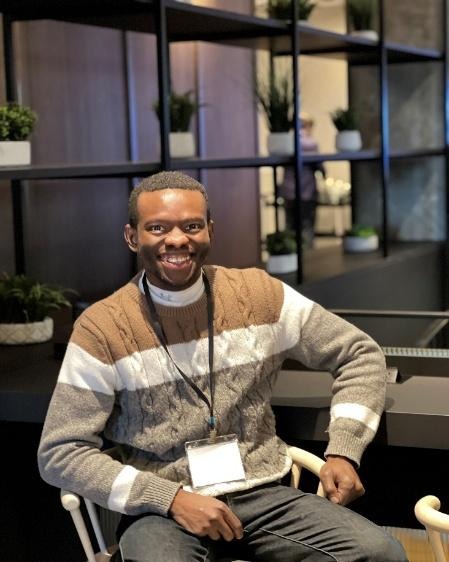
Onyeka Odoh is a PhD Candidate and a Sessional Instructor in the Department of English at the University of Calgary. His research works have appeared in peer-reviewed journals such as Ariel, African Identities, Journal of the African Literature Association, Research in African Literature, CLCWeb: Comparative Literature and Culture, Literature Compass, and Cogent Arts and Humanities.
Categories: BIPOC Caucus, Uncategorized